The hanging of Tom “Black Jack” Ketchum on the 26th of April 1901 is one of the most notorious botched executions in American history — a grim, almost darkly comic disaster in a dusty frontier town, that ended with an outlaw literally losing his head.
Black Jack Ketchum was one of the last great outlaws of the Wild West. Born in Texas in 1863, he grew up hard, lost both his parents young, and drifted from cowboy work into a life of crime alongside his brother. He rode with a gang associated with the infamous “Hole in the Wall” outlaws, and made a name for himself robbing trains across the Southwest. Two lawmen, Sheriff Edward Farr and deputy W. H. Love, died in the posse fight that followed one of the gang’s robberies, though Tom himself was not there.
The Horror
His downfall was almost pitifully bad luck. In July 1899 the gang robbed a Colorado and Southern train near Folsom without Tom. Sam was shot days later in the running fight at Turkey Canyon, was captured, and died of blood poisoning on the 24th of July in the territorial prison at Santa Fe. And Black Jack, apparently undeterred, decided to rob the exact same train — the Colorado and Southern — entirely by himself. A one-man train robbery. It went catastrophically wrong. The train’s conductor, who had been robbed by this gang before and was thoroughly sick of it, grabbed a shotgun and got the drop on Ketchum, blasting his arm to pieces. The blast knocked him from his horse, and he was found beside the track the following morning, too badly wounded to have gone anywhere.
He was taken first to Trinidad, Colorado and then to Santa Fe, where his right arm was amputated in September 1899. He was tried at Clayton, New Mexico — then still a frontier territory, not yet a state — in September 1900. And here’s a strange quirk of the law that sealed his particularly grim fate: he was convicted not of murder, but of “felonious assault upon a railway train” — train robbery itself. Under a harsh New Mexico territorial law, train robbery was a capital crime, punishable by death. Black Jack Ketchum would become the only person ever hanged for train robbery in the history of New Mexico. The statute was later held unconstitutional.
And that’s where the real problem began. Because the town of Clayton had never hanged anyone before. Ever. Its officials had no experience with executions whatsoever, and they were about to learn, in the most horrifying way possible, that hanging a man properly is a precise and technical business.
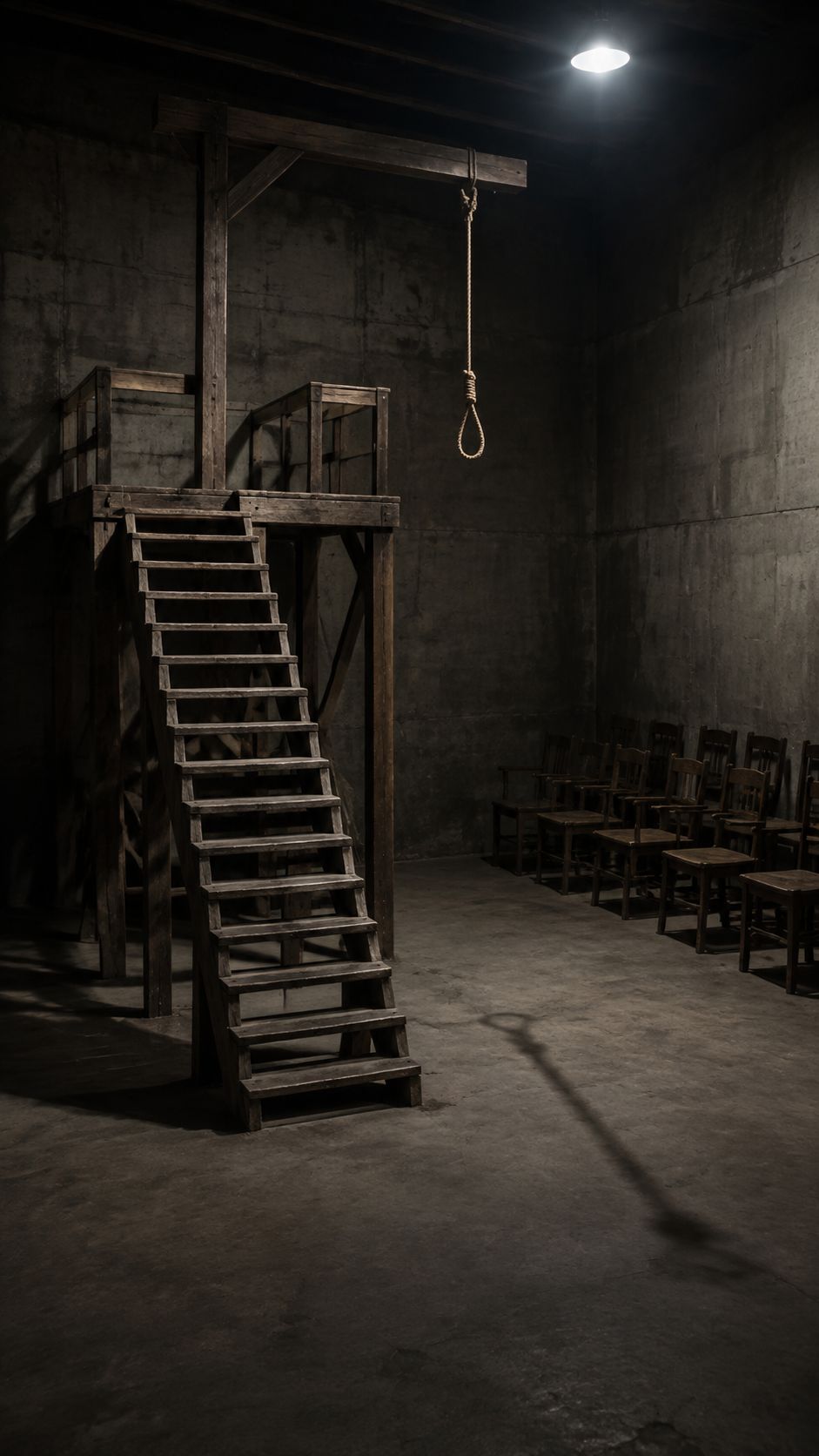
A hanging is supposed to work by carefully calculating the length of the rope against the weight of the condemned, so that the drop is exactly long enough to break the neck cleanly and instantly — quick and, in theory, relatively humane. Too short a drop, and the man slowly strangles. Too long a drop, and the sudden stop can tear the head clean off the body. Clayton’s officials had no idea how to get it right.
The story that they tested the gallows with a 200-pound sandbag and then left it hanging on the rope all night, stretching it into something as unforgiving as wire, is repeated everywhere but rests on no record. What is documented is worse in its ordinariness: the drop was reset from five feet nine inches to a full seven feet, and the rope used was thin and soaped so that it would run freely.
The hanging was a massive public spectacle. People poured in from all over the territory to watch; businesses closed, saloons did a roaring trade, and by the town’s own account the local lawmen sold tickets and even little souvenir dolls of Tom hanging on a stick. Postcards were made of the event. Black Jack himself faced it all with the hard, flippant bravado of a Wild West outlaw to the very end. The gallows joke attached to him — that he would be in hell before the crowd had breakfast — circulates widely and was probably invented after the fact. His recorded last words were simpler: “Good-bye. Please dig my grave very deep. All right — hurry up.”
Then the trap was sprung, and Black Jack Ketchum dropped.
The Modern Relic
Ketchum weighed about thirteen and a half stone, no great bulk, but a seven-foot drop on a thin rope was far more force than his neck could absorb. Instead of cleanly breaking his neck, the rope snapped taut with such brutal force that it tore his head completely from his body. Accounts differ on what the crowd saw next, one contemporary report describing the trunk pitching forward, others claiming it stood for a moment before it fell. It was a scene of shocking carnage that stunned even a Wild West crowd that had come specifically to watch a man die.
The aftermath was almost absurd. The doctor pronounced him dead — which was hardly in doubt — and a photograph was taken of the corpse and later sold as a postcard. The doctor then sewed Black Jack’s head back onto his torso before he was buried. Sheriff Salome Garcia is often quoted insisting that there had been no bungling whatever and that everything worked in perfect order, though no contemporary source for the line has been traced.
Black Jack Ketchum was buried in the local Boot Hill, and his story passed instantly into Wild West legend — the outlaw who joked his way to the gallows and was decapitated by his own execution, the only man New Mexico ever hanged for robbing a train, and one of the last true desperados of a dying frontier era. There’s a poignant footnote, too: on the morning of his death, Ketchum is reported to have posted a letter to President McKinley confessing to several robberies that other men had been wrongly imprisoned for — a last, strange act of conscience from a condemned outlaw.
The relic is out there in the high plains of New Mexico. Ketchum’s grave was moved from Boot Hill to the town cemetery in the 1930s, where it can still be found. The town of Clayton, which had never hanged a man before and never did again, still remembers its one and only, infamously botched execution — the day the frontier learned, in the worst way, exactly how wrong a hanging can go.